Update: Now available – Loving Justice National Plan & Dr. C. Blackstock Affidavit
UPDATE – IMMEDIATE RELEASE
Vancouver, BC, December 22, 2025 – 02:10 PM PST— The Loving Justice Plan: First Nations Child and Family Services (Outside Ontario) was filed pursuant to 2025 CHRT 80 and the Affidavit of (Dr.) C. Blackstock (without exhibits) are now publicly available. Click the links to download the documents.
The “Loving Justice – Plan to End Canada’s Discrimination” presentation is available on the OCOW website, and video recordings are available on the Our Children Our Way YouTube Channel in English and French.
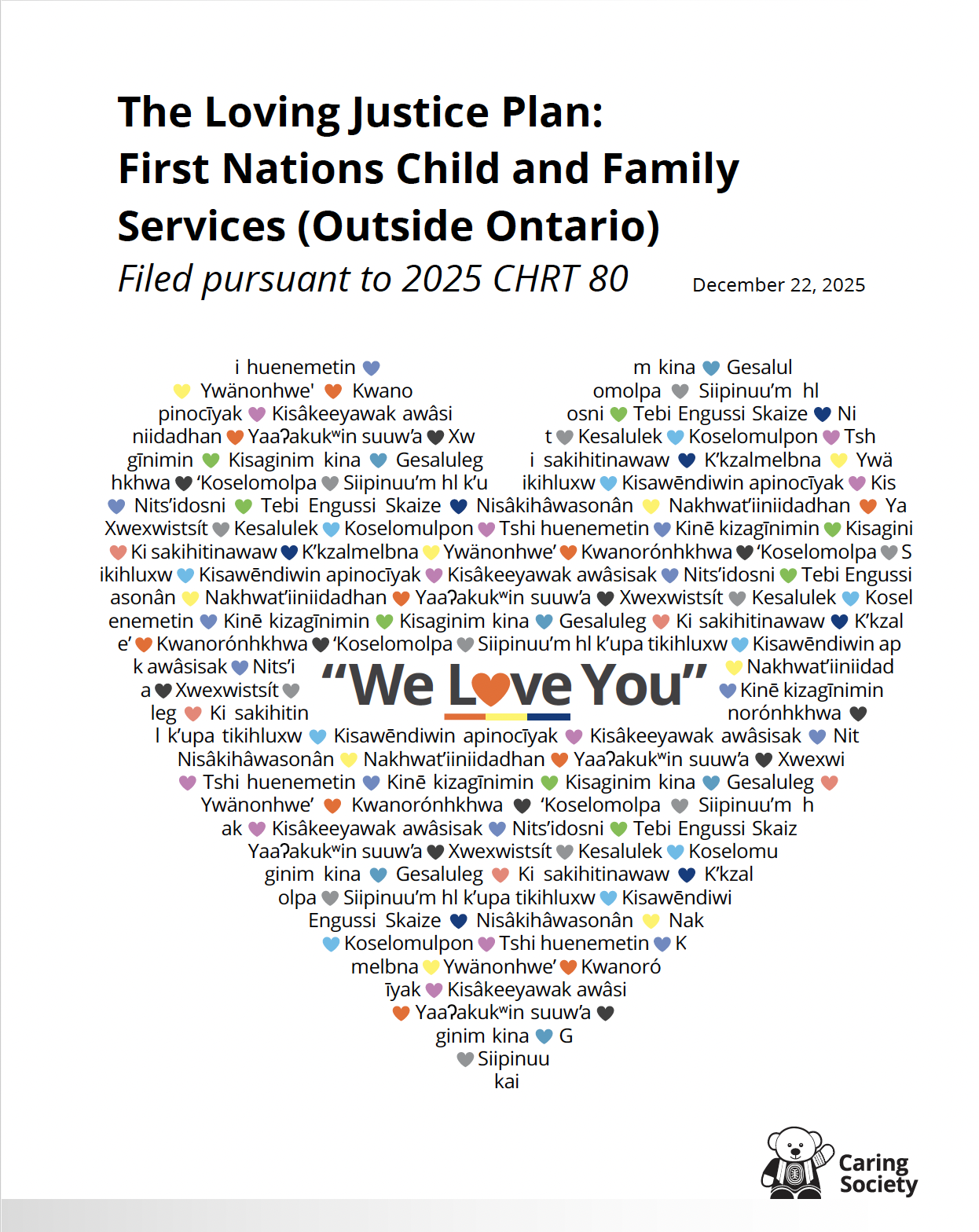
From the Loving Justice Plan
2. Introduction – Page 8
The Loving Justice Plan is organized according to the engagement themes outlined in the National Engagement Guide, namely: 1) purpose, principles and definitions, 2) governance, 3) enforcement and durability, 4) funding commitments and arrangements, 5) accountability, 6) regional variations, 7) reform of Indigenous Services Canada, 8) research and outcome data, and 9) transitions and readiness. These themes were identified based on the direction of First Nations Rights Holders, Tribunal orders, and the best available evidence dating back nearly 30 years.
The content of each theme is informed by the wisdom of First Nations Elders and Knowledge Keepers, youth, and First Nations child and family service experts who participated in the 105 engagement sessions held across Canada pursuant to 2025 CHRT 80. Sixty-four of the submissions were for groups – of up to 91 participants. The National Children’s Chiefs Commission and the First Nations Child and Family Caring Society engaged with First Nations leaders and Rights Holders, Elders, youth and First Nations Child and Family Service (FNCFS) experts to gather their perspectives on the componentsof this Plan. The “What We Heard” sections that follow provide summaries and illustrative quotations of the feedback shared during those engagements.
Their collective wisdom is critical to enabling regional variations to meet local needs, while building upon a national approach to long-term reform that sets fundamental minimum human rights standards and accountability mechanisms to permanently stop Canada’s discrimination in First Nations child and family services.
These reforms, in tandem with regional variations to reflect distinct cultures, languages and realities, will apply to First Nations child and family services excepting First Nations consenting to the application of the Ontario Final Settlement Agreement or its successors. Many First Nations that have affirmed, or are seeking to affirm, their own jurisdiction in child and family services in whole or in part are entitled to the benefits of these reforms as a minimum standard which ought to be upwardly adjusted to reflect the requirements of the respective First Nations law(s).
While recognizing the scope of the complaint, we urge Canada to take measures over and above those contemplated by this plan to extend these reforms and support substantively equitable and culturally appropriate First Nations Child & Family Services to all First Nations children wherever they reside, including off-reserve and in the Northwest Territories.
Throughout its process, the Loving Justice Plan demonstrates the love that First Nations have for their children, youth and families. There was no funding for this process, yet First Nations governments and their experts joined with the National Children’s Chiefs Commission and the Co-Complainants (the Caring Society and the Assembly of First Nations) to ensure the voices of Rights Holders are respected and the rights of their children, youth and families are upheld.
-30-
Loving Justice National Plan to End Canada’s Discrimination in First Nations Child and Family Services
Vancouver, BC, December 22, 2025 – 11:00 AM PST— The National Children’s Chiefs Commission (NCCC) stands with the Assembly of First Nations (AFN) in supporting the First Nations Child & Family Caring Society’s submission of the Loving Justice National Plan to end Canada’s discrimination in First Nations Child and Family Services, filed today with the Canadian Human Rights Tribunal (CHRT).
Upon filing the Loving Justice Plan to permanently end Canada’s discrimination in First Nations Child and Family Services, Caring Society Executive Director, Cindy Blackstock stated:

This National Plan represents decades of First Nations-led work dating back to the 1990s, when research first documented systemic discrimination in Canada’s funding and delivery of First Nations child and family services and identified clear, evidence-based solutions. Had Canada acted on those solutions when they were first presented, the profound harms suffered by First Nations children and families could have been prevented, and Canada would not now be paying $23 billion in compensation for the damage caused by its failure to act.
“This National Plan reflects decades of First Nations–led research, lived experience, and expert advice that clearly identified both the discrimination and the solutions. These are not new ideas. They are well-documented, evidence-based, and rooted in the voices of First Nations children, families, and leaders.
The failure to act on them earlier caused profound harm that was entirely preventable,” says Chief Pauline Frost, Chair of the National Children’s Chiefs Commission.
The National Plan is firmly grounded in:
- the extensive body of research and evidence accumulated over decades;
- the binding legal orders of the Canadian Human Rights Tribunal;
- the expertise of First Nations Child and Family Services professionals; and
- the voices of First Nations leaders and rights holders from across the country.
This Plan establishes minimum national standards for long-term reform that align with the principle of substantive equality, while preserving space for First Nations to negotiate regional variations that go beyond these standards to reflect their distinct needs, priorities, and circumstances.
“The National Plan establishes the minimum standards required to achieve substantive equality for First Nations children and families. It also respects regional diversity by creating space for First Nations to go beyond those standards to meet their own needs. This balance is essential to meaningful, long-term reform,” says Regional Chief Francis Verreault-Paul, AFN portfolio holder for Child & Family Services.
The National Children’s Chiefs Commission, working collaboratively with the Caring Society—and without any support from Canada—engaged extensively with First Nations leaders, rights holders, and subject-matter experts nationwide to ensure this Plan reflects First Nations expertise, lived experience, and diverse perspectives.
“While First Nations have put forward a comprehensive, evidence-based Loving Justice Plan grounded in legal orders and lived realities, Canada has chosen not to work with us to co-develop a path forward. At the same time that Canada is submitting its own plan, it is also seeking judicial review of the very decision that required these plans to be filed today. That contradiction raises serious concerns about Canada’s commitment to ending discrimination,” says Deb Foxcroft, Co-Chair of the National Children’s Chiefs Commission.
The National Children’s Chiefs Commission and the Assembly of First Nations affirms their full support for the National Plan submitted today and call on Canada to uphold its legal obligations, respect First Nations leadership, and implement reforms that finally end discrimination against First Nations children and families.
-30-
Media Contacts:
- Dr. Cindy Blackstock, Executive Director, Caring Society, [email protected], t: 613-230-5885
- Deb Foxcroft, Co-Chair, National Children’s Chiefs Commission, [email protected]
- Francis Verreault-Paul, Regional Chief, AFN Portfolio Holder for FNCFS, [email protected]
*****
POUR DIFFUSION IMMÉDIATE
Plan national « Loving Justice » pour mettre fin à la discrimination du Canada dans les services à l’enfance et à la famille des Premières Nations
Vancouver (C.-B.), le 22 décembre 2025 — La Commission nationale des chefs pour les enfants (CNCE) se joint à l’Assemblée des Premières Nations (APN) pour appuyer le dépôt par la Société de soutien à l’enfance et à la famille des Premières Nations du Plan national « Loving Justice » visant à mettre fin à la discrimination du Canada dans les services à l’enfance et à la famille des Premières Nations, présenté aujourd’hui au Tribunal canadien des droits de la personne (TCDP).
Lors du dépôt du Plan « Loving Justice » pour mettre fin définitivement à la discrimination du Canada dans les services à l’enfance et à la famille des Premières Nations, la directrice générale de la Société de soutien, Cindy Blackstock, a déclaré :
« Ce plan Loving Justice représente la sagesse collective de nombreuses personnes. Il a été béni lors d’une cérémonie du solstice sur le territoire traditionnel des T’Kemlúps te Secwépemc et est enveloppé de messages d’amour dans les langues des Premières Nations. Ce plan regorge de solutions fondées sur des données probantes pour corriger la discrimination du Canada une fois pour toutes — car lorsque les enfants gagnent, nous gagnons tous. »
Ce Plan national est l’aboutissement de décennies de travail dirigé par les Premières Nations, remontant aux années 1990, lorsque des recherches ont pour la première fois documenté la discrimination systémique dans le financement et la prestation des services à l’enfance et à la famille des Premières Nations au Canada, et identifié des solutions claires et fondées sur des preuves. Si le Canada avait agi à l’époque, les préjudices profonds subis par les enfants et les familles des Premières Nations auraient pu être évités, et le pays ne paierait pas aujourd’hui
23 milliards de dollars en compensation pour les dommages causés par son inaction.
« Ce Plan national reflète des décennies de recherches menées par les Premières Nations, d’expériences vécues et de conseils d’experts qui ont clairement identifié à la fois la discrimination et les solutions. Ce ne sont pas de nouvelles idées. Elles sont bien documentées, fondées sur des preuves et enracinées dans les voix des enfants, des familles et des dirigeants des Premières Nations. Le fait de ne pas avoir agi plus tôt a causé des préjudices profonds qui étaient entièrement évitables », déclare la cheffe Pauline Frost, présidente de la Commission nationale des chefs pour les enfants.
Le Plan national repose solidement sur :
- un vaste corpus de recherches et de preuves accumulées au fil des décennies ;
- les ordonnances juridiques contraignantes du Tribunal canadien des droits de la personne ;
- l’expertise des professionnels des services à l’enfance et à la famille des Premières Nations ;
- les voix des dirigeants et des titulaires de droits des Premières Nations à travers le pays.
Ce Plan établit des normes nationales minimales pour une réforme à long terme conforme au principe d’égalité réelle, tout en laissant aux Premières Nations la possibilité de négocier des variations régionales allant au-delà de ces normes pour refléter leurs besoins, priorités et circonstances distincts.
« Le Plan national établit les normes minimales nécessaires pour atteindre l’égalité réelle pour les enfants et les familles des Premières Nations. Il respecte également la diversité régionale en créant un espace permettant aux Premières Nations d’aller au-delà de ces normes pour répondre à leurs propres besoins. Cet équilibre est essentiel pour une réforme significative et durable », affirme le chef régional Francis Verreault-Paul, porteur du dossier des Services à l’enfance et à la famille à l’APN.
La Commission nationale des chefs pour les enfants en collaboration avec la Société de soutien — et sans aucun appui du Canada — a mené de vastes consultations auprès des dirigeants des Premières Nations, des titulaires de droits et des experts à travers le pays afin de s’assurer que ce Plan reflète l’expertise, l’expérience vécue et la diversité des perspectives des Premières Nations.
« Alors que les Premières Nations ont présenté un Plan “Loving Justice” complet et fondé sur des preuves, enraciné dans des ordonnances juridiques et des réalités vécues, le Canada a choisi de ne pas travailler avec nous pour co-développer une voie à suivre. Au même moment où le Canada soumet son propre plan, il cherche également à obtenir un contrôle judiciaire de la décision même qui exigeait le dépôt de ces plans aujourd’hui. Cette contradiction soulève de sérieuses préoccupations quant à l’engagement du Canada à mettre fin à la discrimination », déclare Deb Foxcroft, coprésidente de la Commission nationale des chefs pour les enfants.
La Commission nationale des chefs pour les enfants et l’Assemblée des Premières Nations réaffirment leur plein soutien au Plan national déposé aujourd’hui et appellent le Canada à respecter ses obligations légales, à reconnaître le leadership des Premières Nations et à mettre en œuvre des réformes qui mettent enfin fin à la discrimination envers les enfants et les familles des Premières Nations.
-30-
Contacts médias :
- Dr Cindy Blackstock, Directrice générale, Société de soutien, [email protected] t: 613-230-5885
- Deb Foxcroft, Coprésidente, Commission nationale des chefs pour les enfants, [email protected]
- Francis Verreault-Paul, Chef régional, porteur du dossier à l’APN pour le SEFPN, [email protected]
National Children’s Chiefs Commission is hosted by: ICFSD Our Children Our Way Society